Start delivering measurement based mental health care

Conduct psychological assessments remotely, get scores automatically, and maintain clinical records securely

Create account
Comprehensive Autistic Trait Inventory

Comprehensive Autistic Trait Inventory

What is CATI

The Comprehensive Autistic Trait Inventory (CATI) is a questionnaire designed to measure autistic traits in adults. It was developed to reflect today's understanding of autism, recognising that autistic experiences extend well beyond social communication differences to include areas such as sensory sensitivity, self-regulatory behaviours, and social camouflaging. Unlike many earlier questionnaires, the CATI was created using extensive psychometric testing alongside input from autistic adults, clinicians, and autism researchers to produce a measure that is both scientifically robust and respectful of autistic experiences. Many widely used autistic trait questionnaires were created more than twenty years ago. Since then, our understanding of autism has evolved considerably. The CATI was developed to provide an updated alternative that: • Reflects current understanding of autism • measures both social and non-social autistic characteristics • Uses respectful, accessible language • Provides strong psychometric performance for research and clinical use

CATI Printable PDF

You can create a free account on PsyPack to access fillable PDFs, manuals and educational resources for the CATI

CATI Scoring and Interpretation

All items are scored 1 to 5 (‘Definitely Disagree’ to ‘Definitely Agree’) except items 8, 15, 19, 23, and 28 (highlighted below), which are reversed. Total scale score ranges from 42 – 210, whilst subscales range 7 – 35.

The six subscales are each made up of seven items.

  • SOC = Social Interactions - Items 8, 10, 15, 17, 28, 30, 35
  • COM = Communication - Items 13, 19, 23, 26, 33, 37, 42
  • CAM = Social Camouflage - Items 3, 6, 9, 16, 22, 29, 39
  • REG = Self-regulatory Behaviours - Items 1, 7, 12, 20, 25, 32, 41
  • RIG = Cognitive (In)Flexibility - Items 2, 5, 14, 21, 27, 34, 38
  • SEN = Sensory Sensitivity - Items 4, 11, 18, 24, 31, 36, 40

A total score of 147.5 provides the best balance between identifying autistic and non-autistic adults. However, many autistic people score below this value, and many non-autistic people score above it. Scores may also be influenced by other conditions or individual differences that overlap with autistic traits.

Descriptive statistics describing CATI total-scale and subscale scores for the overall sample and separated by autism group.

Table 5
Non-Autistic (n = 1,279) Autistic (n = 1,322)

25th perc.

50th perc.

75th perc.

25th perc.

50th perc.

75th perc.

Total CATI score

97

119

136

148

163

176

SOC = Social Interactions

15

22

28

25

30

33

COM = Communication

11

14

18

18

22

26

CAM = Social Camouflage

15

19

23.5

23

27

31

REG = Self-regulatory Behaviours

14

19

24

24

28

31

RIG = Cognitive (In)Flexibility

19

23

27

26

29

32

SEN = Sensory Sensitivity

14

19

24

24

29

32

CATI is not a diagnostic assessment.

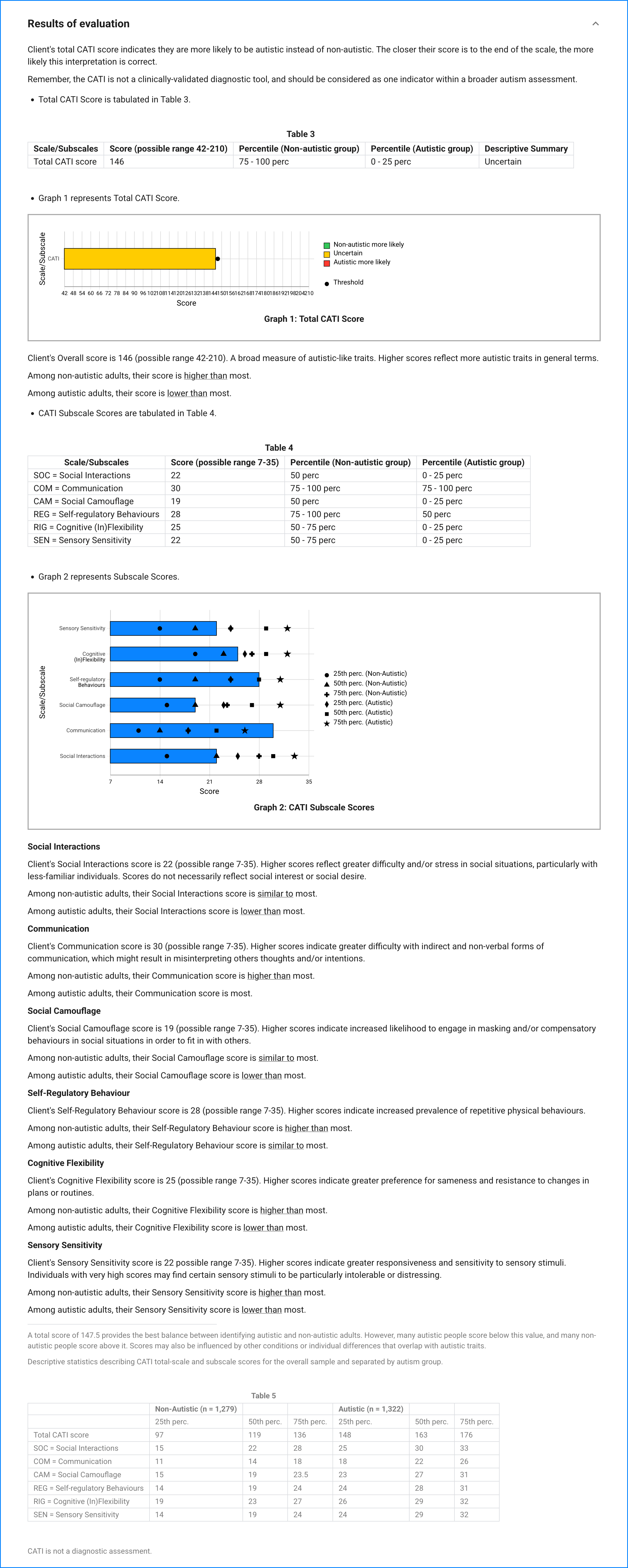
PsyPack can automatically score the CATI assessment and prepare corresponding tables and graphs.

CATI sample result

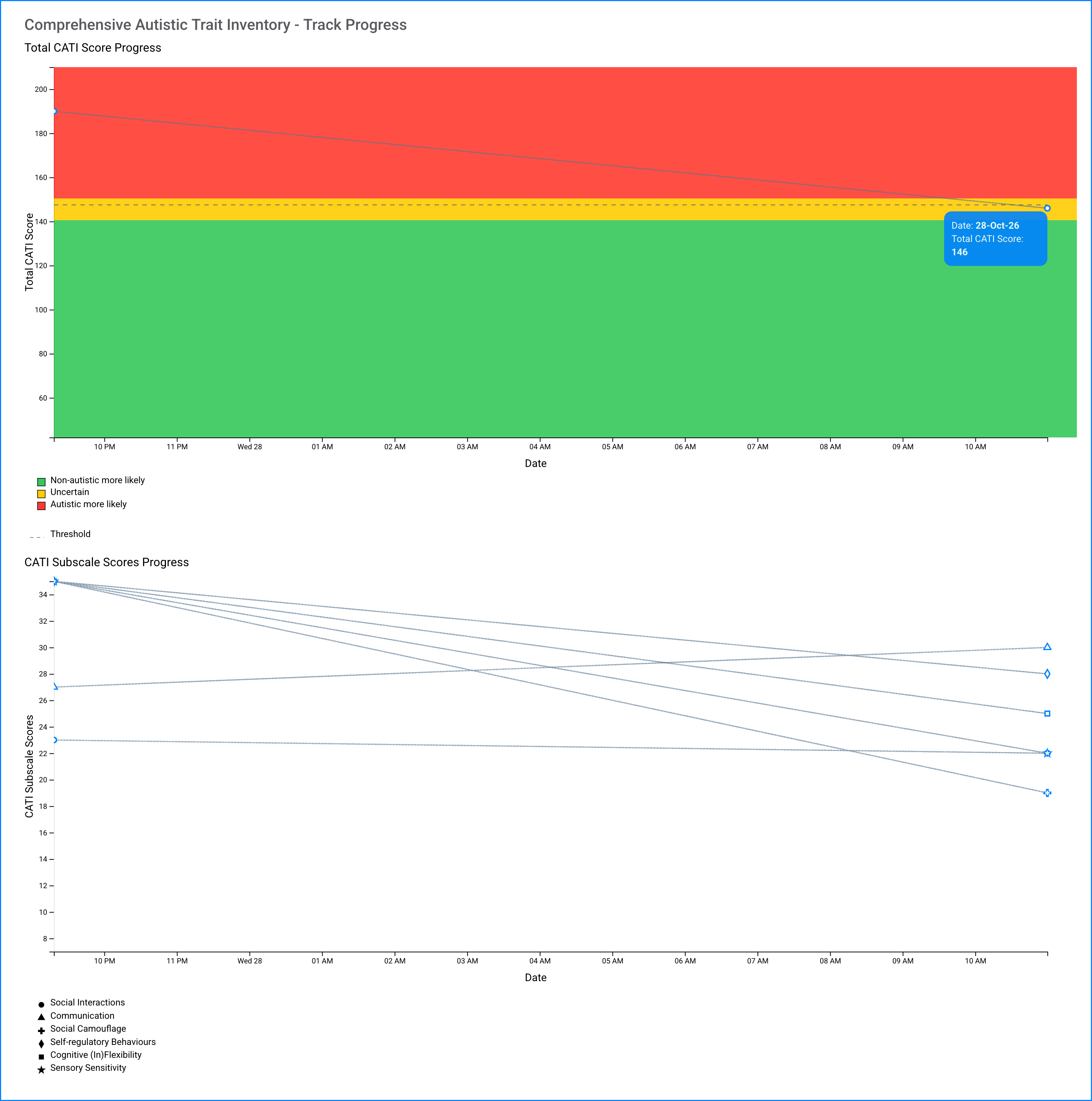
Further, PsyPack automatically plots a graph to help you easily track progress over time.

CATI track progress

Sample Report of CATI

Domain

Social Camouflaging Behaviours, Autism Spectrum Disorders

What does CATI measure

The CATI was primarily developed as a research instrument for measuring autistic traits in adults across both autistic and non-autistic populations. It provides researchers with a comprehensive profile of autistic characteristics that reflects current understanding of autism while maintaining strong psychometric performance.

The CATI may also be useful for:

  • Researchers investigating autistic traits, individual differences, and autism-related outcomes
  • Clinicians, as one component of a broader assessment or screening process
  • Autistic and non-autistic adults seeking greater insight into their own pattern of autistic traits
  • Students and educators learning about the diversity of autistic experiences

Although the CATI has been extensively evaluated in large samples of autistic and non-autistic adults, it is not a diagnostic instrument. It should not be used as the sole basis for diagnosing autism or making clinical decisions. Research supports its use as a measure of autistic traits and suggests it may be valuable within broader screening processes, but formal diagnosis should always involve comprehensive clinical assessment.

Administration

Self-administered

Type of outcome tool

Clinical

Assessment modes

Questionnaire

Age and eligibility

Adults

Estimated time

About 15 minutes

Notes

Since the questionnaire relies on client self-report, all responses should be verified by the clinician, and a definitive diagnosis is made on clinical grounds taking into account how well the client understood the questionnaire, as well as other relevant information from the client.

The CATI is intended to provide a descriptive summary of traits and characteristics qualitatively similar to those found in clinical autism. It is NOT intended to be diagnostic or replace a diagnosis received by qualified clinicians using clinically-validated tools. CATI scores may be influenced by other factors that overlap with autism. If you have any concerns about your scores, please discuss them with your GP.

The CATI should always be interpreted alongside developmental history, clinical interview, behavioural observations, and other validated assessment tools. It should not be used in isolation to diagnose or exclude autism.


Attribution and References

English, M. C. W., Gignac, G. E., Visser, T. A. W., Whitehouse, A. J. O., Enns, J. T., & Maybery, M. T. (2021). The Comprehensive Autistic Trait Inventory (CATI): Development and validation of a new measure of autistic traits in the general population. Molecular Autism, 12(1), 37. https://doi.org/10.1186/s13229-021-00445-7